250C4 Stainless Steel 4-Way Spider Fitting | Investment Cast Glass Curtain Wall Spider
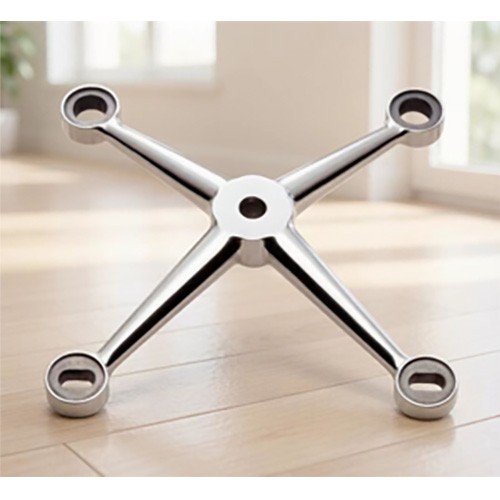
SSHW 250C4 stainless steel 4-way spider fitting. Investment cast CF8M, CF8 or duplex CD3MN, 250 x 250 mm hole spacing, for point-fixed glass walls. Custom and wholesale.
250C4 Stainless Steel 4-Way Spider Fitting for Point-Fixed Glass Curtain Walls
Summary (Quick Answer)
The SSHW 250C4 spider fitting is a four-arm, investment-cast stainless steel connector. It carries four glass panel corners from a single structural support in point-supported facades, canopies and glass partitions. It is produced in CF8M, CF8 or duplex CD3MN.
With 250 × 250 mm hole centers, 26 mm glass holes and a 19 mm central fixing hole, this 4-way spider suits coastal, tropical, desert and temperate climates. Every order is made to project requirements.
Why Choose the SSHW 250C4 Spider Fitting?
1. Corrosion resistance you can match to the environment
CF8 is the cast equivalent of grade 304 and suits interior and mild urban conditions. CF8M is the cast equivalent of grade 316. Its molybdenum content improves resistance to chloride pitting, which makes it the usual choice for coastal and general commercial facades. CD3MN is a cast duplex stainless steel in the 2205 family. It offers higher strength and stronger resistance to pitting and stress corrosion, so it suits salt-laden, pool-side and heavily loaded locations.
2. Investment casting for a one-piece structure
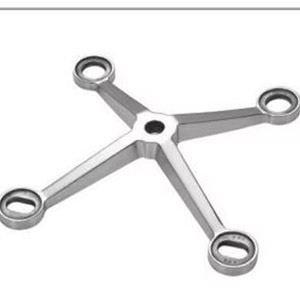
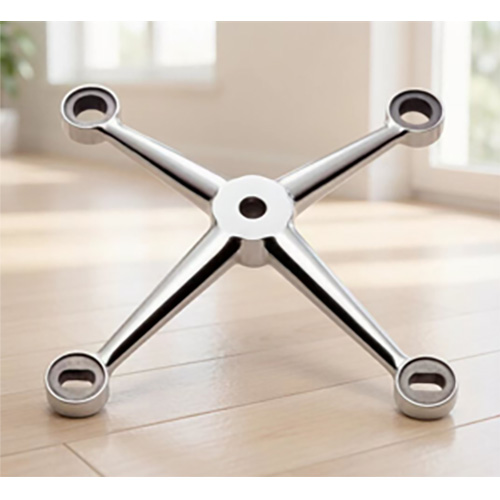
The 250C4 glass spider fitting is made by precision lost-wax investment casting. The four arms and the central boss form a single piece with no welded joints. Each arm tapers smoothly from the center to the arm end, which distributes stress evenly. After casting, the glass holes and central hole are CNC machined and the part is polished.
3. Clearly stated load capacity
The manufacturer's load table for the 250C series gives these recommended values:
- CF8M and CF8: Fx up to 2500 N, Fy up to 1500 N
- CD3MN: Fx up to 3300 N, Fy up to 2000 N
Duplex CD3MN offers roughly one third more recommended capacity in both directions. These are recommended values only. Final design loads, safety factors and glass build-ups must be verified by the project structural engineer.
4. Defined geometry for easy design coordination
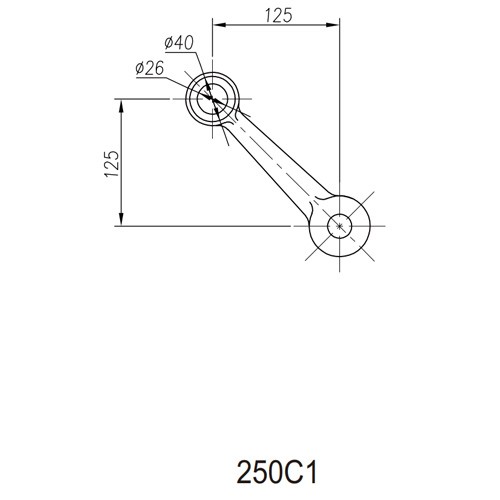
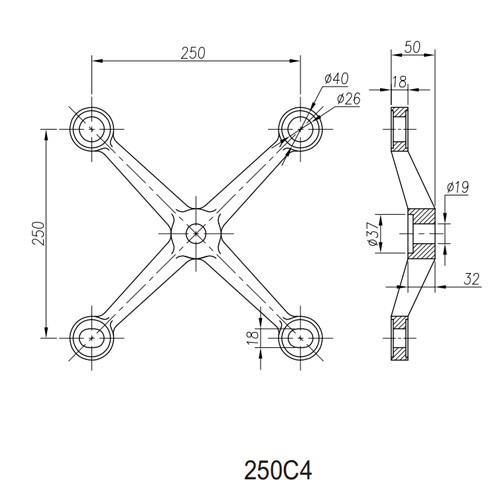
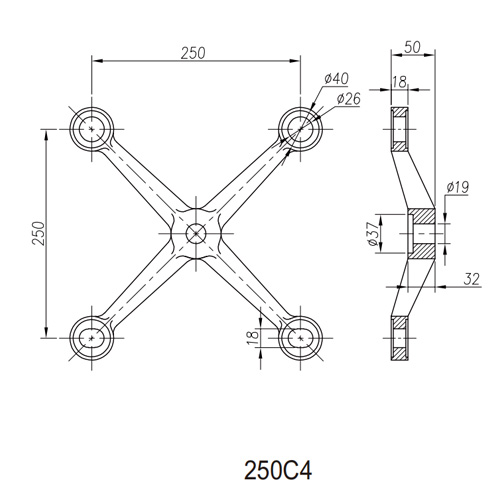
The 250C4 geometry is fully dimensioned:
- Hole spacing of 250 × 250 mm
- Arm end bosses of 40 mm outside diameter and 18 mm thickness
- Glass holes of 26 mm
- Central boss of 37 mm with a 19 mm central hole
- Overall depth of 50 mm, with a 32 mm offset dimension on the drawing
Designers can model the 4 leg spider fitting directly and check clashes early.
5. Adjustable, site-friendly design
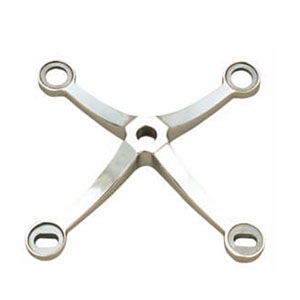
In the product photograph, the two lower arms use slotted holes. These help absorb fabrication and installation tolerance between drilled glass and the supporting steel. The exact mix of round and slotted holes is confirmed per project.
6. Clean mirror aesthetics
The polished four-arm form is simple and strong, and it keeps attention on the transparency of the glass. The same 250C series also offers one-arm, two-arm and three-arm versions, so a whole facade can share one visual language.
Options, Finishes and Mounting Configurations
Material grades
- CF8 (similar to 304): interior, dry and low-corrosion projects.
- CF8M (similar to 316): coastal, urban commercial and general exterior use.
- CD3MN (duplex): high salt exposure, aggressive atmospheres and heavily loaded points.
Related configurations in the 250C series
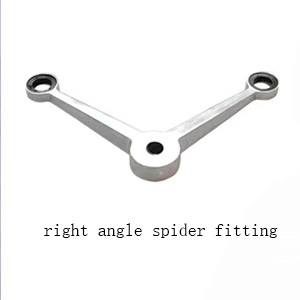
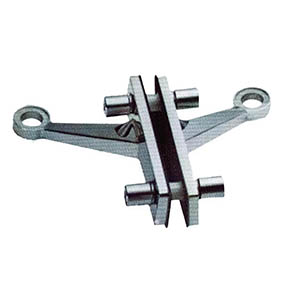
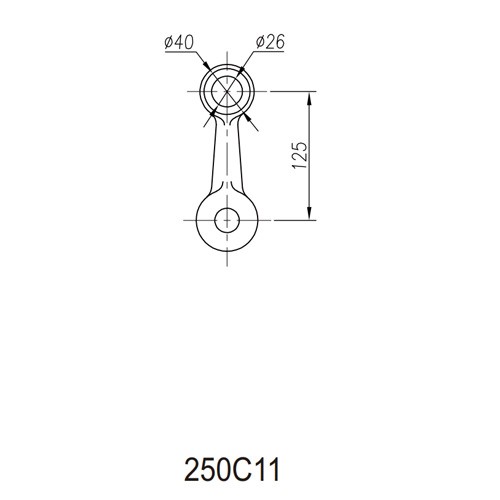
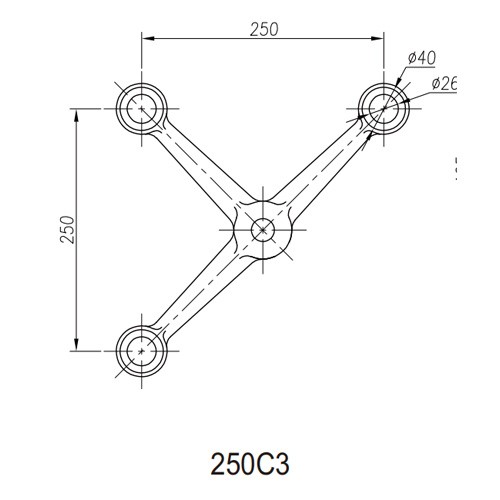
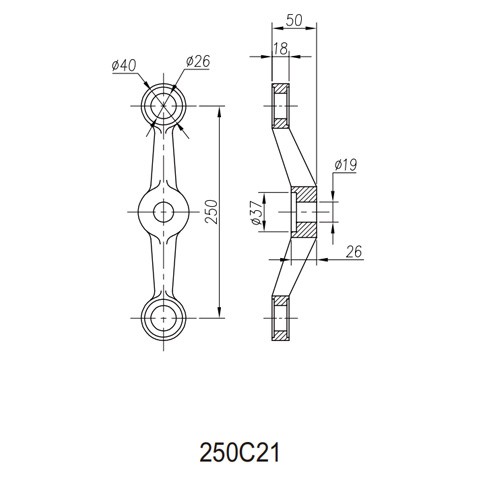
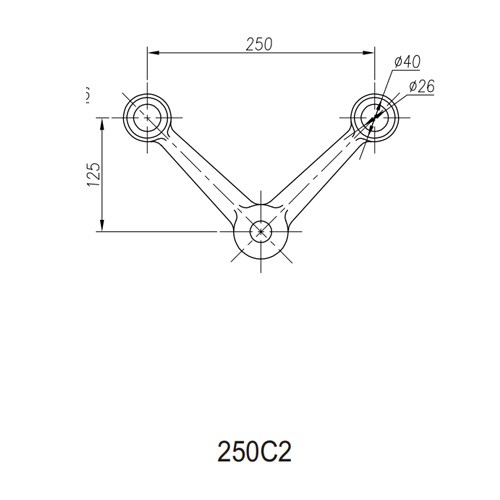
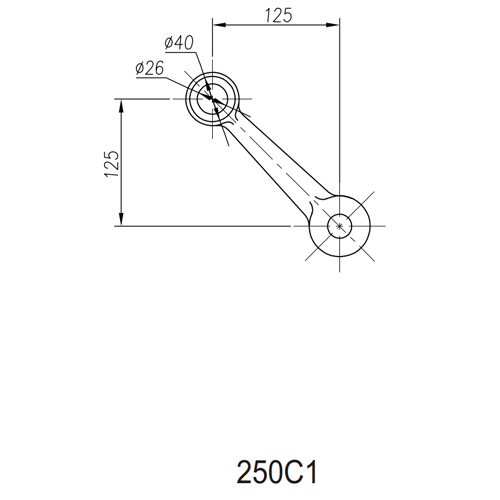
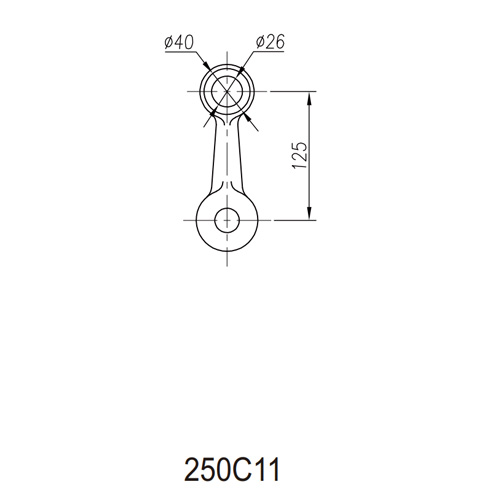
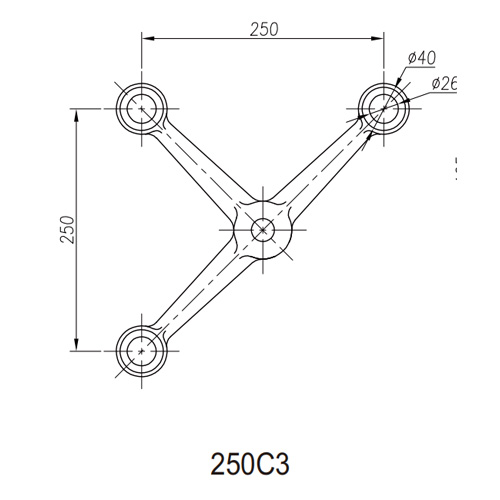
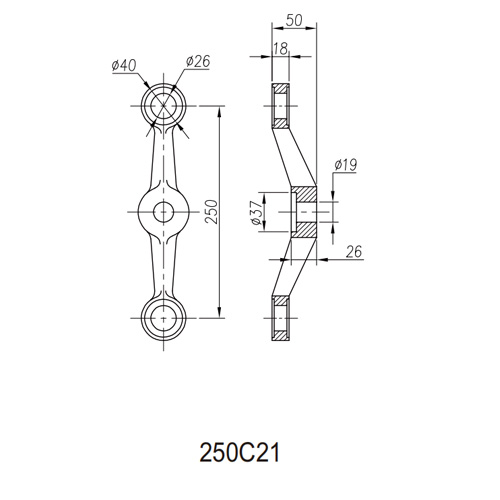
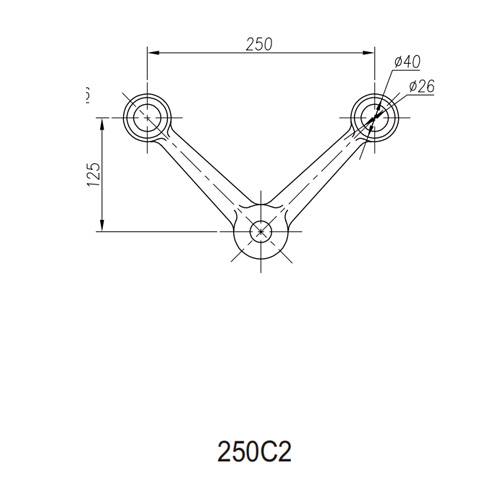
The range includes 250C4 (four arms), 250C3 (three arms), 250C2 (two arms in a V shape), 250C21 (two arms in a straight line), and the single-arm 250C1 and 250C11. The 4-way version is used where four glass corners meet. Edge and corner points can use the other configurations.
Surface finishes
- Mirror polish, as shown in the product photo
- Satin or brushed finish
- Electropolishing or passivation for improved corrosion resistance
- Special colors such as black PVD: available upon request, to be confirmed per project
Mounting and accessories
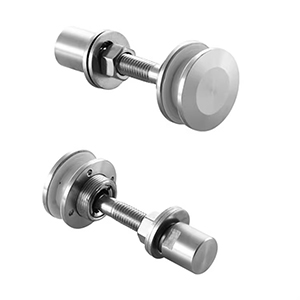
- Glass side: countersunk or articulated spider bolts pass through the 26 mm holes to hold the glass.
- Structure side: the 19 mm central hole connects to a rod, bracket, mullion or steel adapter.
- Gaskets: engineered plastic or EPDM gaskets must separate glass from metal at every point.
- Fasteners: use fasteners of equal or higher corrosion grade than the spider. Bolt specifications are confirmed per project.
Project Selection Checklist
1. Corrosion category of the environment
- Interior, bathroom or dry commercial: CF8 is usually adequate. Consider CF8M in humid wet areas.
- Exterior urban commercial: choose CF8M, ideally with electropolishing or passivation.
- Coastal, pool-side or chemical areas: choose CD3MN first. CF8M can work with a strict cleaning plan.
2. Glass thickness and supporting structure
- Confirm glass type (toughened, laminated toughened or insulated) and thickness, then match the bolt system and gaskets.
- Confirm that your steel interface fits the 19 mm central hole.
- Confirm that your panel layout works with the 250 × 250 mm hole spacing.
3. Safety and load requirements
- Compare wind, dead-load and seismic cases against the recommended Fx and Fy values.
- For heavy loads or tall facades, prefer CD3MN (Fx up to 3300 N, Fy up to 2000 N).
- Safety factors and final calculations are confirmed by the project engineer.
4. Procurement and delivery
- This series is made to order without stock. Confirm quantity, material, finish and lead time early.
Technical Specifications
| Item | Specification |
|---|---|
| Model | 250C4 (4-way spider fitting) |
| Hole spacing | 250 × 250 mm |
| Arm end boss diameter | 40 mm |
| Glass hole diameter | 26 mm |
| Arm end thickness | 18 mm |
| Central boss diameter | 37 mm |
| Central fixing hole | 19 mm |
| Overall depth | 50 mm |
| Offset dimension (drawing) | 32 mm (250C4) |
| Material | CF8M, CF8, CD3MN |
| Recommended load, CF8M/CF8 | Fx up to 2500 N, Fy up to 1500 N |
| Recommended load, CD3MN | Fx up to 3300 N, Fy up to 2000 N |
| Process | Investment casting, CNC machining, polishing |
| Finish | Mirror, satin, electropolished (others upon request) |
| Unit weight | To be confirmed per project |
| Ultimate failure load | Available upon request |
| Material and test reports | Available upon request |
| Supply mode | Customized, made to order |
| Drawing formats | DWG and PDF, available upon request |
Engineering Excellence, Testing and CAD Downloads
How it works: the spider claw is the node of a point-supported glass system. Glass is held at each of the four arm ends by spider bolts. Wind load (the Fx direction) and glass self-weight (the Fy direction) travel through the arms to the center, then into the main structure through the central hole. The tapered arm section lets bending moments change smoothly and avoids stress concentration.
Manufacturing sequence: wax pattern, ceramic shell building, dewaxing and pouring, solution heat treatment, CNC machining of holes, grinding and polishing, cleaning and passivation, and dimensional inspection.
Quality control and testing (available upon request):
- Spectrometer chemical composition analysis (PMI or optical emission)
- Salt spray test reports
- Load and fatigue test data
- Dimensional and visual inspection records
We supply DWG and PDF drawings so design teams can complete detailing quickly. Watch product and installation demonstrations in the SSHW YouTube video playlist. You can also browse every model on our spider fittings category page.
Global Applications and GEO Adaptability
Coastal resorts with high salt spray: chloride is the main cause of pitting on stainless steel. Use CD3MN or electropolished CF8M, and set up a regular fresh-water rinse routine.
Tropical, high-rainfall commercial complexes: under constant humidity, gaskets and drainage details matter. CF8M meets the needs of most projects.
Middle East high-temperature facades and villas: large day-to-night temperature swings cause visible thermal movement. Leave movement allowance at the glass holes and gaskets, and plan for sand and UV exposure. Heavy or tall facades can use CD3MN.
Premium residential and hotel projects in Europe and North America: buyers expect consistent appearance, technical documents and traceability. Mirror or satin CF8M with a complete material file is a common solution.
For background on stainless steel as a material family, see Wikipedia: Stainless steel.
Installation Overview and Maintenance Guide
Installation points
- Before installation, check hole positions, glass drilling accuracy and steel interfaces. Confirm they match the 250 × 250 mm spacing.
- Always place gaskets between glass and metal. Never allow direct contact.
- Use a calibrated torque wrench. Torque values follow the chosen spider bolt system and are confirmed per project.
- Leave clearance for thermal movement and adjustment between glass and spider.
- Seal bolt connections against water so that moisture cannot stay trapped.
Routine maintenance
- Clean interior installations once or twice per year. In coastal and pool areas, clean every three months.
- Use a neutral cleaner and a soft cloth, then rinse with clean water. Do not use chlorine bleach or steel wool.
- To prevent tea staining, choose CF8M or CD3MN, use an electropolished surface, and wash off salt and dirt promptly.
- If you see surface damage, clean it promptly and contact technical support.
Localized Buyer FAQs
Q1 (Perth, Australia): For a project within one kilometer of the coast, should I choose CF8M or CD3MN?
Coastal air deposits salt continuously. CF8M with electropolishing and regular rinsing suits many projects. For high facades that are hard to wash, pool-side areas, or very long design life, duplex CD3MN is the safer choice. Confirm the final choice with a corrosion category assessment.
Q2 (Sharjah, UAE): How does the 250C4 perform in high heat and sand?
Stainless steel tolerates heat well. The main risks are thermal movement and abrasion from sand. Leave movement allowance at the glass holes and gaskets, and clean the facade regularly. For heavy facades, CD3MN offers Fx up to 3300 N and Fy up to 2000 N.
Q3 (Miami, USA): How do I confirm the load suitability of a 250C4 in a hurricane zone?
The drawing gives recommended values: Fx up to 2500 N and Fy up to 1500 N for CF8M and CF8, and Fx up to 3300 N and Fy up to 2000 N for CD3MN. Project wind loads, glass build-up and verification calculations must be completed by the project engineer. Local approval and testing requirements are confirmed per project, and test data is available upon request.
Q4 (Marseille, France): What material documents can I get, and what are the MOQ and lead time for custom orders?
Material composition reports and drawings are available upon request. This series is made to order. MOQ and lead time depend on quantity, material and finish, and are confirmed per project.
Q5 (Jeddah, Saudi Arabia): Will the 250C4 match my existing spider bolts and steel adapters?
The 250C4 has 26 mm glass holes, a 19 mm central hole and an overall depth of 50 mm. Send us your bolt and adapter drawings. We will check the fit and, if needed, adjust hole types such as slotted holes or produce a custom dimension.
Request CAD Drawings and Factory Wholesale Quotation
Working on a point-fixed glass facade, canopy or glass partition? Send SSHW your project location, environment type, glass specification, load requirements, quantity and finish. We will provide:
- DWG and PDF engineering drawings
- Material and test documents (available upon request)
- Factory wholesale and customization quotations
- Recommendations for matching bolts, gaskets and adapters
Visit our spider fittings category page or submit your inquiry today.