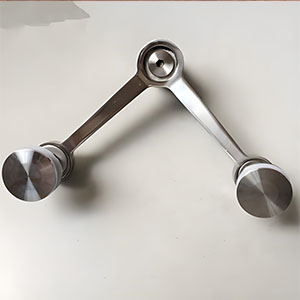
RLL210A2 1-Way Glass Fin Spider Fitting
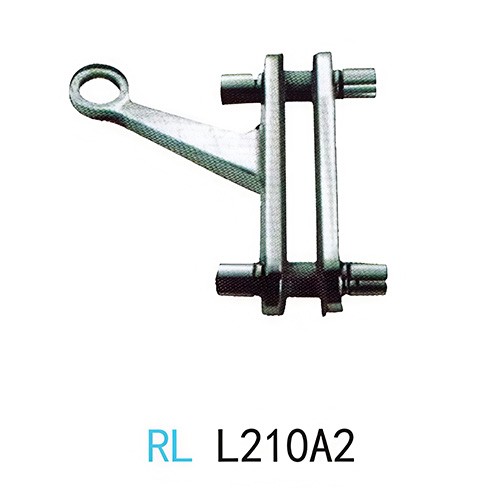
Discover the RLL210A2 1-way fin spider, expertly designed for the edges, tops, and corners of frameless glass facades. Featuring a 10mm solid cast arm and dual-plate clamping for extreme typhoon and salt spray protection. Read our case study from an eco-resort in Palikir, Micronesia.
As an indispensable piece of precision hardware for facade perimeters, it continues the safety legacy of dual-plate clamping while utilizing an asymmetrical single-arm design to perfectly solve the challenge of edge panel securing. Welcome to visit our YouTube channel to watch more machining processes and installation demonstrations of underlying facade metal components: https://www.youtube.com/channel/UC3Lo3jsy1LWw0fH03FHZFug
1. Core Engineering Parameters and Structural Breakdown
The engineering challenge behind the RLL210A2 lies in its anti-torsion capability under single-sided loads. Through rigorous physical and mechanical calculations, this model boasts the following outstanding technical parameters:
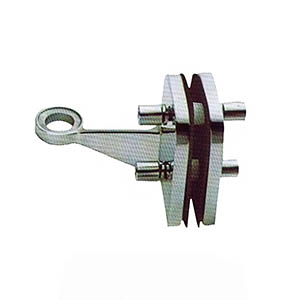
Structural Form: Single-sided, single-arm extension (1-Way Fin Design), exclusively engineered for load-bearing at panel edges and corners.
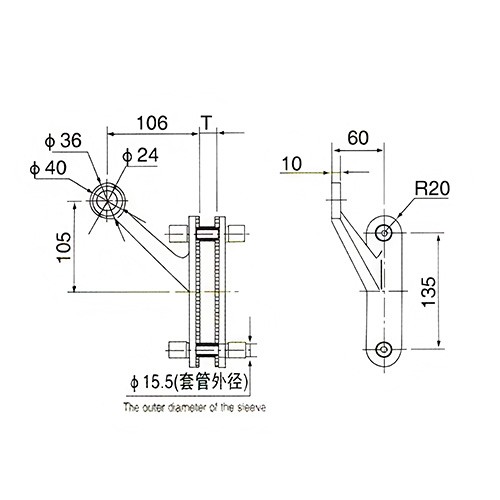
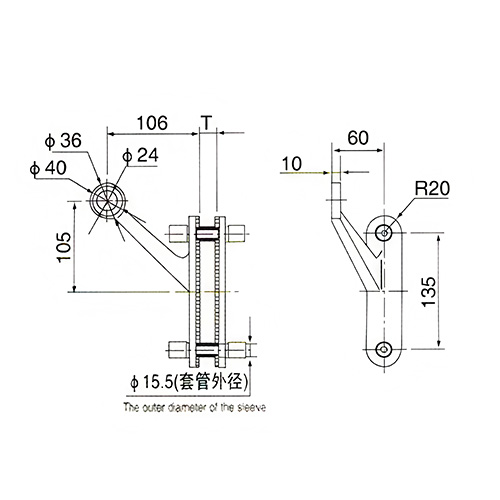
Geometric Span: The horizontal distance from the central axis to the support arm is 106mm, with a vertical offset of 105mm, forming an extremely stable triangular load-bearing zone.
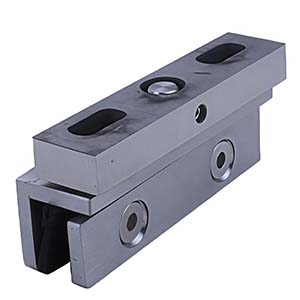
Clamping Zone (T): The central clamping thickness "T" can be custom-adjusted according to the actual thickness of the glass fin (glass mullion). Two solid clamping plates are secured via high-strength bolts with a hole spacing of 135mm.
Anti-Collision System: The bolts are encased in polymer dampening sleeves with an outer diameter of 15.5mm, completely isolating rigid contact between the metal and the glass hole walls.
Arm Thickness & Standoff: The solid support arm reaches a thickness of 10mm. The vertical standoff distance from the edge of the glass fin to the exterior panel is 60mm.
Front Connection: The outer diameter of the arm-end hole is 40mm, with an inner diameter of 24mm, precisely accommodating standard-sized glass routels.
Material Grade: The entire series comes standard in high-salt-spray-resistant SS316 marine-grade stainless steel.
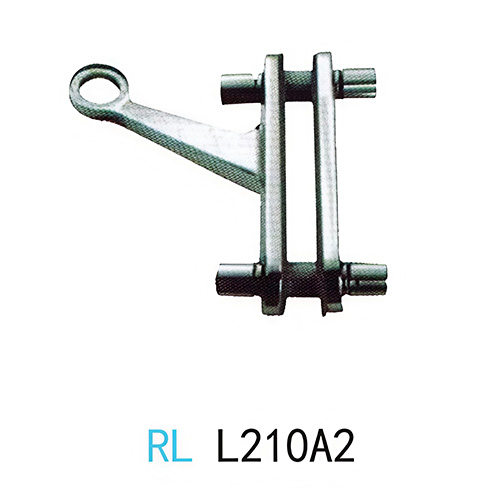
In a frameless transparent building envelope, the RLL210A2 acts as the "goalkeeper." You can visit our fin spider category to see how it works in tandem with multi-way spider fittings.
Scenario-Based Assembly Logic:
At the absolute top, bottom, or the far left and right extremities of the facade, the exterior panels only require securing on one side. Here, installers will pass a [Spider Routel], equipped with a universal ball joint and dampening gaskets, through the panel, locking its tail into the front of the RLL210A2's single arm.
Subsequently, the dual metal plates on the back of the RLL210A2 grip the vertical perimeter glass fin like a vise. In these boundary areas, the bottom of the glass fin usually needs to be firmly anchored to a concrete base or steel beam using a heavy-duty [Bracket / Support Bracket].
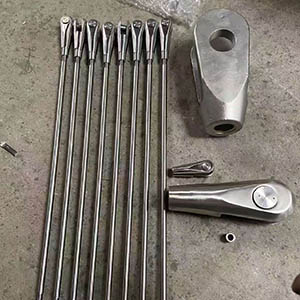
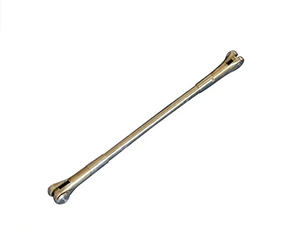
When dealing with ultra-high elevations in typhoon-prone zones, to prevent the perimeter glass fins from lateral deformation under wind pressure, engineers might discreetly add [Tension rods / Stainless Steel Rod] behind the fins for tensile reinforcement. For the edges around ground-level entrance glass doors, [Fixing Clamp / Glass Clamp] hardware is often utilized in conjunction to enhance edge rigidity. Meanwhile, on borders featuring low protective dwarf walls, [Glass spigots] are used to manage the ground-level frameless glass terminations.
Installation Standard Tip:
Because it is a single-sided load-bearing component, the bolt torque of the central clamping plates must be strictly controlled during installation. Ensure the 15.5mm protective sleeves are inserted without omission to prevent the shear force generated by sudden perimeter wind gusts from directly shattering the glass fin.
3. Competitive Advantage: Breaking the Limits of Edge Protection (VS Competitors)
In tropical islands or coastal zones, the edges of a facade are often where wind shear is the most violent. Standard alternatives on the market easily fail here.
Anti-Torsion Rigidity: Many cheap single-arm fittings on the market consist of a single arm bent and welded from thin steel plates. During a typhoon, continuous single-sided pulling easily tears these welds. The RLL210A2 utilizes full lost-wax silica-sol precision casting. The 10mm thick base plate and single arm are cast as one solid piece, possessing incredibly robust anti-torsion and anti-deformation rigidity.
The Absolute Safety of Dual-Plate Clamping: Some competitors handle edges by using single-sided flush mounting with drilled holes. This creates fatal loosening when positive and negative wind pressures alternate. Our "dual-plate sandwich" design bites into the glass fin like jaws, eliminating clearance in any direction.
Corrosion Defense in Tropical Climates: In high-temperature, high-humidity, and salt-laden environments, standard 304 material will bleed unsightly "rust water" within six months. We strictly utilize 316 material, rich in nickel and molybdenum. Combined with pure manual mirror polishing, the surface has zero micropores, perfectly repelling corrosion.
The Federated States of Micronesia is located in the western Pacific Ocean, with beautiful islands scattered around its capital, Palikir. The region features a classic tropical rainforest climate—year-round high temperatures, heavy rainfall, extremely high airborne salinity, and frequent intense Pacific monsoons.
Project Background:
In a newly constructed high-end eco-resort near Palikir, the ocean-facing reception hall features a massive 8-meter-tall all-glass facade. To preserve the unobstructed ocean view, the architect opted for glass fins as structural supports. At the top terminations and lateral boundaries of this facade, an exceptionally robust one-way fixing component was required.
Deep Dive into Pain Points:
The Pacific tropical environment is a brutally harsh test for hardware (creating high demand for specialized tropical architectural hardware). The project team had two primary fears: first, whether the single-sided edge fittings would cause the glass to crack due to stress concentration during the monsoon season; second, whether rust bleeding from the metal parts would ruin the luxurious image of the resort.
Authentic Customer Feedback:
Mr. Aloka, the Facility Engineering Manager for the resort, sent us an email after the rainy season: "Initially, I was highly concerned about whether the edge glass of the main hall would vibrate violently during the monsoon season. However, the performance of these single-arm fittings has been absolutely flawless! The dual-plate clamping structure anchors onto the glass mullions as steadily as rock. After enduring a full year of high-salinity Pacific sea breezes and two major tropical storms, our edge seals remain perfectly intact. What surprised me the most is how its pristine finish perfectly complements our minimalist design. After a year of intense environmental testing, it still shines like new, with zero signs of the rust bleeding stains we’ve experienced on past projects. Those dampening sleeves absorbed all the vibration noise, providing our guests with an incredibly quiet and transparent space to view the ocean."
5. Structured FAQ
Q1: What is the load-bearing difference between the single-arm fitting (RLL210A2) and a 4-way fitting?
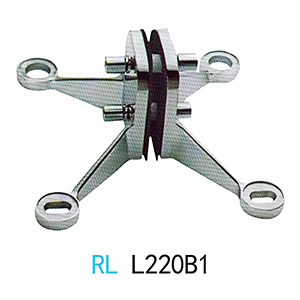
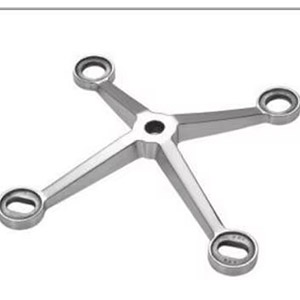
A: A 4-way fitting is primarily used in the central area of a facade to bear and distribute the intersecting loads of four panels. The single-arm (RLL210A2) is specifically engineered for the edges, corners, or top/bottom terminations of the facade. It is designed to handle the concentrated wind load of a single glass panel's edge, and the mechanical strength of its single arm has been specially reinforced.
Q2: Can it be installed on the edges of a sloped glass canopy or skylight?
A: Yes. As long as it is paired with a glass Routel that features a multi-directional articulating head, the RLL210A2 can perfectly adapt to securing the edges of sloped glass canopies or skylights within a certain angle range.
Q3: If our location not only has typhoons but also intense direct sunlight, will the clamps crush the glass as it expands?
A: Absolutely not. We equip the fitting with 15.5mm polymer isolation sleeves and flexible gaskets on the inner side of the clamping plates. These are specifically designed to reserve ample physical buffering space for thermal expansion and contraction in tropical environments. While guaranteeing structural strength, they allow the glass to safely expand under the scorching sun.